Rare Minerals of Malawi
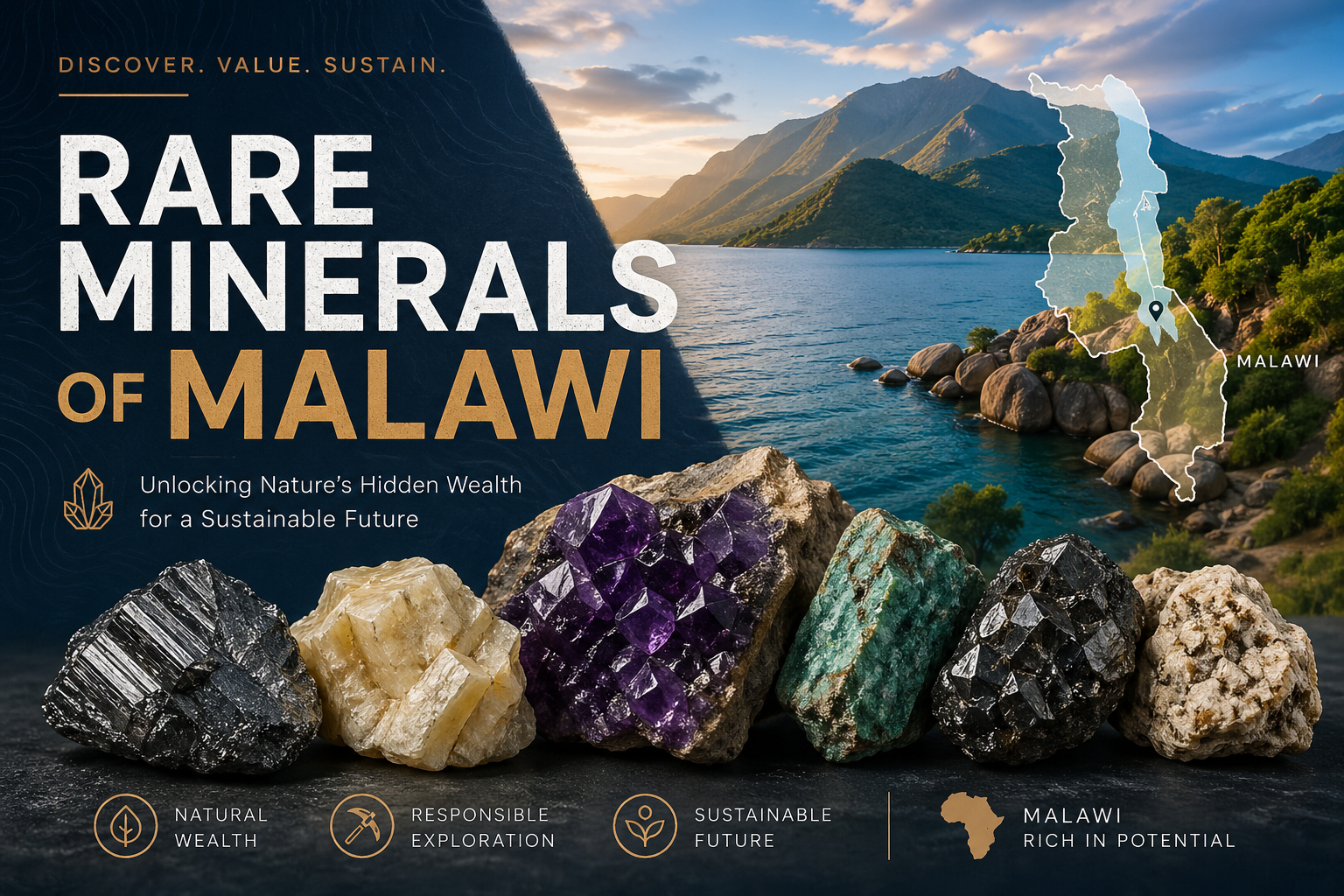
Beneath the Warm Heart: Malawi's Rare Minerals and the Race for the Earth's Hidden Elements
Malawi is best known for its lake, its tea estates, and the unhurried rhythm of life that earned it the nickname "the Warm Heart of Africa." What it is *not* known for, at least not yet, is sitting on top of one of the most strategically important mineral troves on the continent. That is changing, and quickly.
Beneath the gentle hills of Balaka, the carbonatite plugs of Phalombe, and the weathered ridges of the Kirk Range lies a geological inheritance that is suddenly very interesting to Tokyo, Brussels, Washington, and Canberra. From rare earth elements that power electric motors to gem-quality rubies that glow under afternoon sun, Malawi's mineral story is one of long-overlooked wealth finally meeting global demand.
Here is a look at what lies beneath the surface.
Rare Earth Elements: The Quiet Giants
When people say "rare earths," they usually mean a group of seventeen elements — the lanthanides plus scandium and yttrium — that are essential to almost every piece of modern technology. They go into the magnets in electric vehicle motors, the gearboxes of wind turbines, the guidance systems of missiles, and the screens of smartphones. China currently produces around 60 percent of global supply, a dominance that has unsettled governments from Washington to Brussels and sent them scrambling for alternatives.
Malawi has two world-class rare earth projects, and both are about to start producing.
Kangankunde
In Balaka District, in the country's southern highlands, sits the Kangankunde carbonatite — a roughly conical plug of unusual rock that geologists have known about for decades but never developed at scale. It is now controlled by Australian-listed Lindian Resources, which has called Kangankunde one of the most attractive rare earth projects globally on the basis of its high grade and low impurities. First production is targeted for the fourth quarter of 2026, with mine stripping already underway, the first blast scheduled for April 2026, and grid power energisation due in July.
The numbers attached to Kangankunde are worth pausing on. Lindian raised roughly A$100 million in early 2026 in an oversubscribed institutional placement, fully funding Stage 1 construction without taking on debt. The Malawi government has approved an expansion of the mining licence area from 900 hectares to 2,500 hectares. A senior United States delegation visited the site in early 2026 to assess its role in national security and the energy transition — diplomatic attention rarely lavished on a single mine in a country of fewer than twenty million people.
Kangankunde is monazite-hosted, meaning the rare earth elements are bound up in the mineral monazite, which is enriched in neodymium and praseodymium — the two elements most critical for permanent magnets. That is not an accident of marketing. It is what makes this deposit globally relevant.
Songwe Hill
About sixty kilometres to the east, between Lake Chilwa and the Mulanje Massif, lies Songwe Hill — an 800-metre-diameter carbonatite-fenite complex being developed by Canadian-listed Mkango Resources through its subsidiary Lancaster Exploration. Songwe is older as a project, with feasibility studies stretching back to 2014 and a definitive study completed in 2022. An updated feasibility study was released in March 2026, alongside a pre-feasibility study for a downstream separation plant in Puławy, Poland, where the concentrate will be processed into the individual rare earth oxides that buyers actually want.
Songwe has been designated a strategic project under the European Union's Critical Raw Materials Act — a status that confers preferential treatment in procurement and financing. The mine is expected to have an 18-year life, with initial capital investment of around US$325 million.
Together, these two projects could make Malawi Africa's largest rare earth producer by the end of the decade. Benchmark Mineral Intelligence forecasts that roughly 30 percent of African rare earth supply will come from Songwe Hill and Kangankunde combined.
Niobium and Tantalum: The Kanyika Story
Up in Mzimba District, the Kanyika project hosts a different kind of strategic deposit — niobium, tantalum, uranium, and zirconium, all bound up in the mineral pyrochlore. Niobium is used in high-strength steel for pipelines, cars, and bridges. Tantalum goes into the capacitors inside almost every consumer electronic device. Both are on every major economy's critical minerals list.
Kanyika has been studied for years and remains one of the larger undeveloped pyrochlore deposits outside Brazil. Its development would diversify a global niobium market currently dominated almost entirely by a single Brazilian company.
Graphite and Rutile: Kasiya's Twin Prize
In the central region near Lilongwe, the Kasiya deposit is one of the more unusual finds in recent African geology — a single project hosting both rutile (a titanium mineral used in pigments, aerospace alloys, and welding rods) and natural flake graphite (used in lithium-ion battery anodes). Held by Sovereign Metals, Kasiya has been described as one of the largest natural rutile deposits in the world and one of the largest flake graphite deposits as well. Test work on Kasiya graphite has produced consistently strong results for battery-grade applications, and the project sits relatively close to existing rail infrastructure that could carry concentrate to the Mozambican coast.
Uranium at Kayelekera
Malawi's first major modern mine was the Kayelekera uranium project in Karonga, in the far north. Opened by Australia's Paladin Energy in 2009, it produced around 10.9 million pounds of uranium oxide before being placed on care and maintenance in 2014 due to weak prices. The mine was sold to Lotus Resources in 2020. With uranium prices having recovered substantially as nuclear energy returns to favour as a low-carbon baseload source, Kayelekera has been moving toward restart — a reminder that "rare" sometimes just means "uneconomic until the world changes its mind."
The Gemstones: Older, Quieter, Beautiful
Long before the rare earth rush, Malawi was a gemstone country — though one that has never quite stepped into the spotlight occupied by Mozambique or Tanzania.
Chimwadzulu Hill
The country's most storied gem mine sits about 145 kilometres south of Lilongwe, on a hill called Chimwadzulu in the Kirk Range. The deposit was discovered in 1958, making it one of the oldest documented corundum mines in Africa. The geology is unusual: a serpentinised peridotite — an ultramafic rock — that has been altered by metasomatism, the same kind of geological setting that produces the famous rubies of Montepuez in Mozambique, Winza in Tanzania, and Didy in Madagascar.
Chimwadzulu is best known for its rubies and orange sapphires, but most of what comes out of the ground is actually pale green, blue, and yellow sapphire. A 4.71-carat blue sapphire from the deposit now sits in the Smithsonian Gem Gallery. The mine has changed hands several times; in 2013, Malawian national Abdul Mahomed acquired the majority interest, with the government and a local consortium holding the remainder
.
Beyond Chimwadzulu
Malawi's gemstone footprint is wider than Chimwadzulu alone. The country produces aquamarine, emerald, garnets (almandine, spessartite, rhodolite, and rare green varieties), amethyst, rose quartz, rock crystal, tourmaline, agate, spinel, cordierite, and even jade. New ruby occurrences have been reported at Makanjira, near Lake Malawi. Green garnet and gem-quality spinel have been found in the marble belts of the Bwanje Valley and Makoko. Mica pegmatites scattered across Mzimba, Rumphi, Chitipa, Ntcheu, Neno, Mangochi, Zomba, Mulanje, Chikwawa, and Nsanje have produced beryl, tourmaline, and quartz varieties for decades, often through small-scale and artisanal miners.
What Could Go Right, and What Could Go Wrong
Malawi's mineral moment is real, but it is not guaranteed.
The opportunity is enormous. The mining sector currently contributes around one percent of GDP. Government targets aim for ten percent by 2063, and projects like Kangankunde and Songwe Hill could plausibly deliver a significant share of that. Beyond direct revenue, the sector promises tax income, jobs, and the kind of infrastructure investment — power, rail, roads — that tends to spill over into the broader economy.
The risks are equally real. Civil society organisations have already pushed back on the size and scope of mining licences, with the Centre for Democracy and Economic Development Initiatives publicly arguing that Kangankunde's medium-scale licence undervalues a deposit that ought to be classified as large-scale, with greater state participation and benefit. Malawi's mining code does allow for free carried interest in large-scale projects, but how that gets applied in practice is a live political question. Infrastructure remains a bottleneck — limited rail, constrained power supply, and a regulatory regime that has not yet been stress-tested at full production scale.
There is also the persistent issue of value addition. Exporting raw concentrate is the easiest path, but it is also the one that leaves the most money on the table. The Songwe-Puławy partnership is interesting precisely because it is one of the few African rare earth projects that has lined up downstream processing in advance, even if the processing happens in Poland rather than Malawi.
A Country Worth Watching
There is something quietly remarkable about a small, landlocked nation finding itself at the centre of a global supply chain shift it did not ask for. Malawi did not seek out the rare earth boom; the rare earth boom found Malawi. Whether the country can convert geological luck into lasting prosperity will depend on a hundred decisions, made by ministers and miners and parliamentarians and village chiefs, over the next several years.
The minerals have been there all along — folded into carbonatite plugs three hundred million years ago, scattered down hillsides by tropical weathering, locked into pegmatites that crystallised before there were continents in their current shape. What is new is that the world finally needs them. That is the part of the story still being written.
---
Sources for this post include Mining Technology, Lindian Resources, Mkango Resources, the U.S. International Trade Administration, GIA, Gem-A, Benchmark Mineral Intelligence, and reporting from Malawi24, Ecofin Agency, and The Habari Network.
Comments (0)
Sign in to leave a comment.
No comments yet. Be the first to share your thoughts!